
Insights
26MAR 2026
The Heat Is On: Addressing the Challenge of Rising Rack Densities in HPC Environments
Cooling is now a top priority for High Performance Computing environments. Modern processors, used in applications from AI training to scientific modelling, are denser, faster, and generate significantly more heat than those from a decade ago. As rack temperatures rise and available floor space decreases, traditional cooling infrastructure is increasingly inadequate.
This article examines the urgent challenge of managing extreme heat density in modern server racks. It explores the causes of this issue, the limitations of conventional cooling methods, and how ColdLogik rear door heat exchangers from Usystems provide a practical, proven solution.
Why Heat Density Has Become a Crisis
For most of computing history, Moore's Law kept processors on a steady path: more transistors, more performance, roughly every two years. For a long time, that performance increase did not come with an equivalent rise in heat output. But that relationship has changed. As transistors have shrunk to near-atomic scales, the physics of heat dissipation has become one of the central engineering problems of our time.
Today's high-end CPUs and GPUs, particularly those built for AI inference, machine learning, and scientific computing, draw hundreds of watts per chip. A single rack populated with accelerators and supporting hardware can now push power loads that would have been unthinkable in a standard data centre just a decade ago. When you consider that traditional facilities were typically designed around much lower average rack densities, the scale of the problem becomes clear.
As a result, HPC providers are operating next-generation workloads on infrastructure not designed for such demands. Addressing this requires a fundamental change in cooling strategy.
The Limits of Air Cooling
Air cooling remains suitable for many data centre environments. However, in high-density HPC deployments, its limitations become increasingly difficult to manage as rack power rises.
Traditional computer room air conditioning (CRAC) units circulate chilled air to remove heat, assuming an even distribution of heat across the room. While this works at lower rack densities, it is ineffective at the higher power levels required by modern HPC hardware.
The challenges with air cooling at high density include:
- Hot spots are forming within and around densely packed racks, where exhaust air cannot be removed quickly enough.
- Increased airflow requirements that put pressure on raised floor systems and perforated tiles not designed for those volumes
- Cold aisle and hot aisle separation is becoming harder to maintain as heat loads intensify.
- Higher energy consumption as CRAC units work harder and less effectively to compensate
- Physical floor space limitations mean that adding more CRAC units is not always possible, particularly in existing facilities.
Some operators reduce processor counts per rack to manage heat, but this undermines the benefits of high-density HPC infrastructure. This results in underutilised rack space and power capacity.
Struggling to manage rising rack densities within your current operation. Our team can assess your environment and help you identify practical cooling options that fit your existing infrastructure.
The Cost of Getting It Wrong
If cooling cannot match the heat load, the consequences are significant and costly. Processors automatically reduce performance when temperatures exceed safe limits, resulting in slower workloads. In severe cases, equipment may shut down to prevent thermal damage.
Consistently high operating temperatures accelerate hardware degradation. Components that could last five or six years in optimal conditions may fail much sooner. For HPC providers with specialised hardware, this directly impacts capital expenditure planning and total cost of ownership.
There is also a reputational risk. HPC providers offering colocation or managed services are contractually obligated to maintain uptime and performance. Cooling failures that cause downtime or reduced performance present both operational and commercial challenges.
Why Conventional Liquid Cooling Approaches Have Their Own Challenges
The data centre industry has recognised the heat density issue for several years, leading to increased interest in liquid cooling. Liquid is much more effective at absorbing heat than air; for example, water has a heat capacity about 3,500 times greater by volume. This makes it well-suited for high-density environments.
Two main approaches have gained attention: immersion cooling and direct chip liquid cooling (DLCC). While both offer technical advantages, each presents challenges that complicate large-scale deployment, especially in existing facilities.
Not sure which cooling approach is right for your data centre We work with HPC providers to review cooling strategies and match solutions to real operational demands.
Immersion Cooling
Immersion cooling involves submerging IT equipment in a tank of non-conductive dielectric fluid. The fluid absorbs heat directly from the components, providing extremely effective thermal management even at very high densities.
Immersion cooling requires purpose-built tanks, specialised fluid management systems, and hardware designed or adapted for immersion. This represents a major capital investment and significant infrastructure changes, making it impractical for many existing facilities. Additionally, secondary cooling is still required to remove heat from the fluid.
Direct Chip Liquid Cooling
Direct chip liquid cooling uses cold plates or heat sinks attached directly to processors, with chilled water circulated through small pipes to carry heat away. It is highly targeted and effective at removing heat from the specific components that generate the most of it.
The main limitation is coverage. Direct chip liquid cooling typically addresses only 60 to 80 percent of the heat generated in a rack. The remaining heat from storage, memory, power supplies, and other components must still be managed, usually with air cooling. As a result, it often supplements rather than replaces air cooling, increasing complexity and cost without fully resolving the issue.
ColdLogik Rear Door Heat Exchangers: A Different Approach
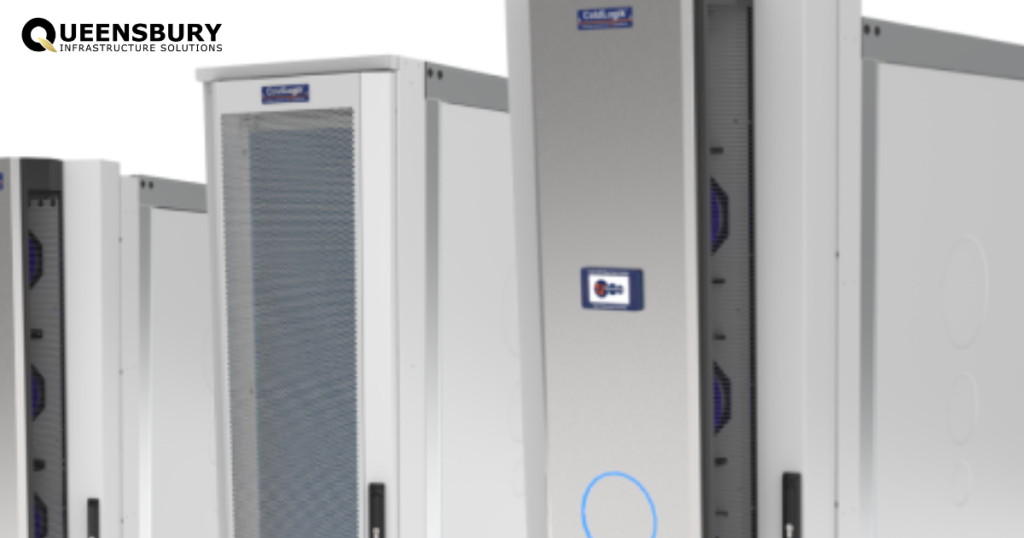
ColdLogik rear door heat exchangers (RDHx), available through Queensbury Infrastructure Solutions, offer a different approach to managing heat density. Instead of replacing air cooling or targeting specific components, they operate at the rack level to neutralise heat before it enters the room.
The rear door heat exchanger replaces the standard rear door of a server rack with a unit containing a heat exchanger coil that circulates chilled water. As hot exhaust air exits the rack, it passes over the coil, transferring heat into the water. The cooled air is then expelled back into the room at or near ambient temperature, while the heat is removed via the chilled water circuit.
How the ColdLogik Active RDHx Works
The ColdLogik active rear door heat exchanger, including the CL20 and CL23 models, incorporates EC fans within the door chassis to enhance airflow over the heat exchanger coil. This enables the system to handle higher heat loads and provides active control over the cooling process.
The active ColdLogik RDHx features adaptive intelligence that monitors conditions and automatically adjusts fan speed and water flow to maintain the target room temperature. The system actively manages the thermal environment rather than simply reacting to heat.
As a result, the ColdLogik active RDHx can remove all heat generated by IT equipment in the rack. No residual heat is transferred to the room air, eliminating the need for supplementary CRAC cooling. Room temperature is managed entirely by the RDHx units.
What This Means for HPC Providers
For HPC providers dealing with high-density racks, this approach offers several important practical advantages:
- High rack densities can be managed without redesigning the facility or replacing the room-level cooling infrastructure.
- Existing data centre designs, including standard rack configurations and conventional chilled water supply, can support the ColdLogik solution without major modification.
- The adaptive intelligence built into active units means the system responds automatically to changing load conditions, without manual intervention.
- There is no risk of water ingress to IT equipment, as the heat exchanger is contained within the door and the water circuit is fully separated from the rack contents.
- The ColdLogik CL20 has been available since 2007. This is not an emerging technology but a proven solution with a long track record of deployment in demanding environments worldwide.
For colocation providers, the flexibility of the ColdLogik approach is particularly valuable. When you do not know in advance what hardware a client will bring into their cages or what density they will eventually run at, having a cooling solution that can scale with the load is a significant operational advantage.
Conclusion
The heat density challenge for HPC providers will persist as workloads such as AI, machine learning, simulation, and scientific research continue to demand greater processing power and generate more heat. Providers who adopt scalable cooling solutions now will be better positioned than those who rely on outdated air cooling methods.
ColdLogik rear door heat exchangers, available through Queensbury Infrastructure Solutions, provide a proven and flexible solution. They integrate with existing infrastructure, scale with rack density, and enable operators to manage high-performance environments confidently.
Interested in Working With Us
Queensbury Infrastructure Solutions works with data centre operators and HPC providers to address the challenges created by rising rack densities. We focus on practical solutions that can be deployed within existing environments, without unnecessary disruption.
To learn more about how ColdLogik Rear Door Heat Exchangers can support your HPC environment, contact the team at Queensbury Infrastructure Solutions.

Leave a Comment